Movie Reviews of The Central Park Five and West of Memphis by Howard Casner
Posted: November 5, 2012 | Author: Donald | Filed under: Uncategorized | Tags: Amy Berg, Billy McMillan, David McMahon, Ken Burns, Sarah Burns, The Central Park Five, West memphis 3, West of Memphis | 6 Comments »At the screening of The Central Park Five, a documentary about the 1989 wrongful conviction of five black teenagers accused of raping and beating a jogger in Central Park (perhaps most famous now, which might be a sad commentary on the incident as well as society as a whole, for giving us the term “wilding”), one of the directors, Sarah Burns, hoped it would make us angry. And how I would have loved that to have happened. I know I should be outraged. I know I should be furious and upset at the bigotry and injustice shown here. And I am. But, as much as I hate to say it, I just can’t say that this movie had anything to do with producing those feelings in me.
The movie is written and directed by Ken Burns, Sarah Burns and David McMahon. Ken Burns is the producer/director of all those amazing PBS documentaries seen on American Experience. But the first thing that strikes you upon seeing this film is how unlike Ken Burns’ usual fare the movie is. If anything, it almost seems anti-Burns in the style of shooting, trading in his cool, collected and to the point approach to a style that seems more to resemble a patchwork quilt, a kaleidoscope of talking heads (and not particularly informative or effective ones this time round) interrupted by everyday scenes of New York City. I’m not convinced that this approach really helped here and may have worked against the effectiveness of the movie. But I also don’t think this was the real problem with the film either.
For me, the problem with the movie is two fold. The first half is filled with talking head interviews of the five men wrongly convicted (well, four; one wouldn’t let his face be shown) detailing what happened to them the night of the incident and how they were manipulated during the following days of interrogation by the police to confess to something they didn’t do (if you’ve seen Law & Order, you know how this goes). It’s not that this isn’t interesting or invaluable. It is a part of the story and must be told. But as awful as what happened to the five was, from an aesthetic point of view, these interviews quickly outlasted their need. They go on and on and on, the remarks feeling more and more redundant, telling us the same thing over and over and over again, until finally, if truth be told, they become a bit of a slog to get through.
Which leads to the second problem and for me, the more serious one. Ironically, even though everything that happened to these five characters was terrible, horrendous, inexcusable, they don’t have the real story to tell. The real story, the information the audience really needs, lies on the other side. It’s the story of the police, the DA’s office and the government people involved; what they did; why they did it; how they did it. But, unfortunately for the filmmakers here, they ain’t talking. At the beginning of the movie, we are told that the police department and others involved refused to be interviewed for the movie (my guess is because they are all being sued by the five involved).
But I hate to be cruel and I hate to be judgmental, but when it comes to the movie, that’s not really my problem as an audience member. If the creator of a documentary can’t get the interviews and information they need to make the documentary work, they have to find some other way to get the information or change the focus of the documentary. Here, one gets the impression that the filmmakers made the latter choice, focusing on what the Central Park Five went through the night of the incident. One can understand why they did it. It’s just unfortunate that that choice not only doesn’t get the job done, it actually works against it.
In contrast, as the lights were coming up after the screening of West of Memphis, another documentary about a miscarriage of justice, I turned to my friend and said, now that’s how you make a documentary. West of Memphis is about those three teenagers accused of murdering three young boys in West Memphis, Arkansas. If you’ve heard of this case, it’s because three previous documentaries have already been made, the Paradise Lost films that have been shown on HBO.
I have to be honest. I was filled with a slight case of trepidation before seeing the film. I had already seen the previous three documentaries and was wondering what could these filmmakers (writers Billy McMillan and Amy Berg and directed by Berg) add to what I already knew (other than bringing in some celeb narrators like that oversized Hobbit Peter Jackson, who had a lot to do with this film getting made; Eddie Vedder; and Henry Rollins). And I guess to be honest, I’m not sure the filmmakers did. But what they did do is an amazing job of bringing it all together and really summarizing everything about the case in a clear and often very emotional and deeply moving manner.
It also helps give the viewer an interesting retrospective and demonstrates how manipulative documentaries can be. When I saw the first Paradise Lost film, I came way with the idea that the West Memphis three quite possibly could have done it (Damien Echols especially gave me the willies). Then in the second film, the suggestion was that Mark Byers, a stepfather to one of the murdered boys, was responsible. But then in the third documentary it turned out, no, Byers didn’t do it. The film concluded that Terry Hobbs, another stepfather, probably did it. In fact, as they state in West of Memphis, the only real reason people gravitated toward Byers as the murderer is that he is so weird—the main reason why the West Memphis three were accused of the crime in the first place.
The movie is filled with some wonderful set pieces and bits of irony: a stop by a turtle farm to demonstrate that the wounds on the boys were probably not made by a knife, but by, of all things, the slow and steady members of the race; the idea that everyone was hoping that the judge in the case would be elected to office so he would no longer be able to hold back the appeals process; and the oddest moment of all, Terry Hobbs suing the Dixie Chicks for libel. The singing group was encouraged to allow the suit to go forward because if they did, Hobbs would have to go on record and be asked anything anybody wanted (and they did and he did and what a basket case Hobbs turned out to be)—and the Chicks had nothing to worry about because they actually didn’t say anything remotely libelous. What Hobbs was thinking is beyond me; but in the end, he never came across as someone who was particularly big in the thinking department.
The West Memphis Three were finally able to get out of prison on one of those odd laws that if you told someone it existed, they wouldn’t believe you. The law would allow the three to accept a guilty plea, but maintain their innocence (very reminiscent of the Scotch verdict—where a person is found guilty but not proven by the jury and is let go). Using this kind of loophole would save the state a lot of money (since the three wouldn’t be able to sue for what happened to them) and embarrassment while getting Echols off death row. It wasn’t a completely satisfactory solution, but it helped bring an end to a horrifying situation. And when the three walked out that door free at last, it has a huge emotional impact.
Movie Review of EVERYBODY IN OUR FAMILY by Howard Casner
Posted: November 3, 2012 | Author: Donald | Filed under: Uncategorized | Tags: Corina Sabau, Everybody in Our Family, Radu Jude | 3 Comments »Everybody in Our Family is a new Romanian film directed by Radu Jude, who also penned the screenplay along with Corina Sabau. It’s about a divorced man who arrives to pick up his five year old daughter for a pre-arranged weekend visit, only to find his ex-wife not home and his mother-in-law and the man who’s replaced him in his wife’s life refusing to let him have his daughter because they claim she’s ill. When the wife gets home, police are called and matters get out of hand (you know, sort of like that fire started by O’Leary’s cow getting out of hand).
Have you ever been at a restaurant or coffee shop and a couple at a nearby table is having a knock down, drag out? You can’t look away, but at the same time, you have no context for the argument so nothing they say really makes enough sense or gives you the information you need to understand the conflict. So in the end, the whole thing becomes just kind of uncomfortable and embarrassing. That’s what watching this Eastern European Kramer v. Kramer is like. It’s a series of arguments and actions presented without enough of that all important context to really have an emotional stake in what’s going on.
Everybody in Our Family is very sincere (that’s one thing you can definitely say about it) and no one gives a bad performance, but it has little else to really recommend it. From a pacing standpoint, it feels a bit clunky (it takes forever for the other shoe to drop—we call it the inciting incident in screenplay patois) and then when the central character makes a fateful decision toward the end, it’s so fateful, there’s no place for the movie to go, and worse yet, it takes forever not to go there. It’s so fateful, and dramatized in such an over the top way (a few times, the characters tell the others to stop acting like they’re in a soap opera, which is something one wishes someone had told the writers and director) there’s no satisfactory way this movie could resolve itself. And sure enough, the authors paint themselves into such a corner that the whole thing ends, well, unsatisfactorily.
Movie Reviews of LUNCH and MADRID 1987 by Howard Casner
Posted: November 2, 2012 | Author: Donald | Filed under: Uncategorized | Tags: Arthur Hiller, Arthur Marx, David Trueba, Donna Kanter, Gary Owens, Jose Sacristan, Lunch movie, Madrid 1987, Maria Valcerde, Monty Hall, Sid Caesar | 980 Comments »I know I’m supposed to love Lunch. It’s that new documentary by Donna Kanter that films a group of elderly comics, comic writers and others involved in the comedic industry as they meet for their every other Wednesday lunch, as has been their wont for forty years now. I know I’m suppose to wonder at the stellar group that has gathered here (from Sid Caesar to Monty Hall to Arthur’s Marx and Hiller) and be in awe at their august gathering. And most important of all, I know I’m suppose to find everything they say to be hysterically funny (I know this last because not only have the reviews said so, but every character in the film tells me how funny they are as well, over and over again).
So I’m sorry, already. I didn’t love Lunch and may the shame on me fall where it may. But I think my trouble with it was that the promise of a great corn beef on rye served with a triple helping of incomparable wit just never materialized. The people talked, they bantered, they told their stories. But nothing they said was that humorous or funny. It certainly was no Algonquin Table (which in turn was no Algonquin Table itself). It was just a bunch of regular guys getting together for lunch.
The most interesting aspect of the film is the talking head interviews that interrupt the three course dinner (soup, sandwich and desert). These were often informative and give you some interesting historical feedback like Arthur Marx’s relationship with his father Groucho and how Monty Hall got to make all those deals (and, yes, it also confirmed that Gary Owens really does sound like that in everyday life). So it’s not that it never worked for me. It just fell sort of flat. So in the end, though I know Lunch is supposed to be the greatest thing since sliced bread, if truth be told, it kinda felt more like chopped liver.
Madrid 1987 also starts out in an eating establishment. This new film from Spain, written and directed by David Trueba, begins with Miguel, a famous writer (played by Jose Sacristan), sitting at a table in a restaurant with all the snarky splendor of Waldo Lydecker in the movie Laura, waxing wittily to a waiter (much wittier than the wits in Lunch, that’s for sure). He is then joined by Angela (Maria Valcerde), an up and coming writer who is there to interview the older practitioner of her art and get feedback on her writing. Or so she thinks. What soon becomes clear is that Miguel has no interest in Angela as a writer, but only wants to have sex with her. And with that change in the plot, Miguel, who was intriguing and charismatic at first, suddenly becomes sad and pathetic, and his wit now falls thuddingly and embarrassingly flat.
Not only does the movie never really recover from this turn in the plot, the worst thing that could happen for the audience then happens. The two characters get locked in a bathroom with no clothes on and no hope of a way out until someone can come rescue them (don’t ask—even if I told you how it happened, I couldn’t make it believable). So there we are, stuck with these two uninteresting characters as they talk about…well, I don’t know, things, and, well, other things, and then, well, other, other things, I guess, until the movie comes to an end.
There’s nothing here to really grasp onto dramatically. There’s not that strong a conflict. The main problem here is that Angela is never a particularly believable or realistic character (she’s more a male construct). Why she goes back to an apartment with this old geezer who she can’t possibly find attractive and why she gets undressed for him and why she then, well, you get where I’m going with this, never remotely makes sense. And without Angela having some sort of goal or reason for being in the movie, there’s no place for the movie to go (especially since there’s no place for the characters to go, stuck in the loo as they are).
I’m not sure why the film is called Madrid 1987 or why it takes place in that year. The date may have some significance to a Spanish audience that might actually shed some light on the actions of the characters. But as the film stands now, it felt at times like it was taking all of 1987 just to watch it.
Movie Review of GAYBY by Howard Casner
Posted: November 1, 2012 | Author: Donald | Filed under: Uncategorized | Tags: Adam Driver, Alex Karposvky, Gayby, Jenn Harris, Jonathan Lisecki, Matthew Wilkas, mumblecore | 6,900 Comments »There is a line repeated a couple of times in the new indie Gayby in which the hero, Matt, asks a potential sexual partner if they can not go below the waist. I have to be honest. I’m not even sure exactly what that means when it comes to doing the deed (except it seems to suggest they won’t be doing it). But at the same time, I think in many ways, it’s a rather apt description of the movie. Gayby is a perfectly okay movie. It’s solidly done and one has to give street creds to writer/director Jonathan Lisecki (who also plays Nellie Bear Nelson in it) for getting it done-no mean feat these days. It also gets some laughs and has some moving moments. At the same time, it never really rises above what it is. It never takes any real chances. It doesn’t have much of an edge. It’s very non-threatening. It’s also one of those movies with gay characters and gay subject matter in which all the sex in it is straight. In other words, it never really goes below the waist.
The basic premise of Gayby is that a straight woman, Jenn (played appropriately enough by Jenn Harris), wants a baby, but is tired of the Sisyphean task of trying to find a husband in New York City (don’t you find it odd in movies like this that the central character who continually wails that it’s impossible for anybody to find a mate in any city is usually the only single person in the whole film?). So she asks her best gay friend Matt (played by Matthew Wilkas—don’t worry, that’s where the naming pattern ends) to impregnate her. And he agrees. At the same time, Matt is still recovering from the break up of a six year relationship that apparently was so bad that he asked his ex- to not come by the comic book store Matt owns on the days that Matt is there, even though the ex- is in the comic book business (at the end Matt makes a request of this ex- that is suppose to suggest a fulfillment of his character arc, but suggested instead to me the opposite and more indicated someone who makes bad business decisions).
But in the end, for all its positive points, Gayby is more for people who have never seen Will & Grace, or actually any movie in the last twenty years that revolves around gay parenthood. The only original take here is that Jenn wants to get pregnant the old fashioned way—by the missionary position. It’s an interesting idea, but since it really only takes up a minute part of the movie and is never really a driving force of the story, it doesn’t really add much to what has come before. Beyond this, Gayby is a pretty familiar story with pretty familiar conflicts played out in pretty familiar ways (with all the characters living in the most amazing apartments and homes that seem far beyond their pay grade). The only really clever twist comes toward the end and show promise, but since Gayby is basically an extended sit-com episode, even that doesn’t really cause that much of a ruckus. By the time the whole thing is over, everyone has found their happy ending with everything resolved in rash free and comforting bunting (there is one note of ambiguity at the end that is very odd—and it’s unclear why Lipinski does this).
As a writer, Lipinski has a way with a clever bitch of a line and is having a ton of fun with an inside look at how the younger generation of gays see themselves with all their personal patois and inside look at themselves (what’s funny is that the very young Matt is already feeling he is being left behind by this younger set). However, Lipinski is not as deft when it comes to the acting. Though no one can be said to give a bad performance, at the same time, everybody hits their lines a bit too hard, telegraphing their emotions a bit too much. It works against the humor at times with scenes often falling flat.
At the same time, it must be said that when it comes to the acting, there are some welcome additions here in two refugees from the mumblecore movement: Adam Driver (who plays Lena Dunham’s boyfriend on Girls—he has one of the most fascinating faces in movies today—he shouldn’t be sexy looking, but somehow he is) and Alex Karposvky. What Parker Posey and James LeGros were to the independent movies of the ‘80’s and ‘90’s, Karposvky is to mumblecore—always a welcome sight.
And Gayby is a mumblecore film with all its virtues and faults. From a virtue standpoint, it got done. Someone decided he wanted to make a film and found a way to do it. From a fault standpoint the film is also, if truth be told, a bit bland with no ambition to be anything more than a safe, not below the waist evening in the movie theater. From one point of view, I suppose it’s great that we now know that mumblecore swings both ways. I think that says a lot for mumblecore. I’m not sure it really says quite as much when it comes to movies with gay characters.
Movie Review of BURN by Howard Casner
Posted: October 30, 2012 | Author: Donald | Filed under: Uncategorized | Tags: Brenna Sanchez, Burn, Burn movie, Tom Putnam | 8 Comments »BURN: One Year on the Front Lines of the Battle to Save Detroit is the new documentary by Tom Putnam and Brenna Sanchez that focuses mainly on one fire station in Detroit as well as on the city’s new fire chief. The movie is for those who have seen Scary Movie 4 and thought that the after and before pictures of Detroit under attack by Martians was a joke. Apparently, it’s not. Detroit has the most fires per capita in the U.S. and things don’t look like they are going to get better any time soon.
The movie holds your attention and there are moving moments as well as some strong character studies of a young fire fighter now confined to a wheelchair and who will never fight fires again and an old timer who is going to retire at the end of the movie. There’s also an interesting character study of Donald Austin, the Executive Fire Commissioner: he comes across as rather foolish and in over his head and one wonders if he would have agreed to be in the movie if he had realized what the results would have been. And it’s all set against some harrowing scenes of fires blazing away and men putting themselves in harms way.
But in the end, it feels as something is missing that prevents it from being more than it is. In many ways, it feels like a movie searching for a message or focus, caught between being a character study of first responders and a study of what exactly is wrong with the fire department in Detroit. And this rock and hard place is understandable. No matter how much the filmmakers may have wanted it to be only a character study, it’s impossible for them to get away from the serious issues facing Detroit. It just keeps sticking its ugly head in.
And Detroit is in trouble. Besides the fire per capita issue, Detroit has lost a third or more of its population; there are 80,000 abandoned buildings; fire equipment is in need of repair and there’s no money to keep them from constantly breaking down or for purchasing new ones; and the fire fighters have to take second jobs just to make ends meet. As the filmmakers show the city, it looks like the perfect location for someone wanting to make a movie about a post-apocalypse America.
And this is where the movie really gets frustrating as it slowly, but irretrievably, becomes a film about a problem that has no solution. The fire fighters blame the city and government and the Fire Chief blames the fire fighters. But what is really odd here is that the filmmakers, for whatever reason, never ask the Mayor, the City Council, the local media, the state government, any experts, anybody else at all about what is really going on. It just seems odd that if that if almost half of the movie is going to be about Detroit falling apart and how handicapped the fire department is, that the filmmakers wouldn’t really go for it. Instead it comes across more as a documentary that, as a friend of mine says, just doesn’t have enough meat to it.
The film is divided into four sections, one for each season of the year. The final section is fall. This section is filled with upbeat images of hope and people finding new possibilities in their futures. But it’s too late and to be ruthlessly honest, it’s a bunch of hokum. Nothing’s changed. The problems are still there looming as large as they were before. It may say fall in the subtitles, but on screen, it’s basically no different than the winter the whole story started with. The ending here doesn’t feel like a reflection of everything the documentary has said before. It feels more like an ending based on a business decision, something to make the audience feel good when they leave the theater. It may make a difference at the box office, but all it really does is let the causes of Detroit’s problems off the hook—the last image for the audience is not “something must be done”; instead, it’s more of, “yes, it’s horrible, but we’re the people and we’ll get by”.
“DANCER”……One Trade You DON’T Wanna Miss!
Posted: October 30, 2012 | Author: Donald | Filed under: Uncategorized | 8 Comments »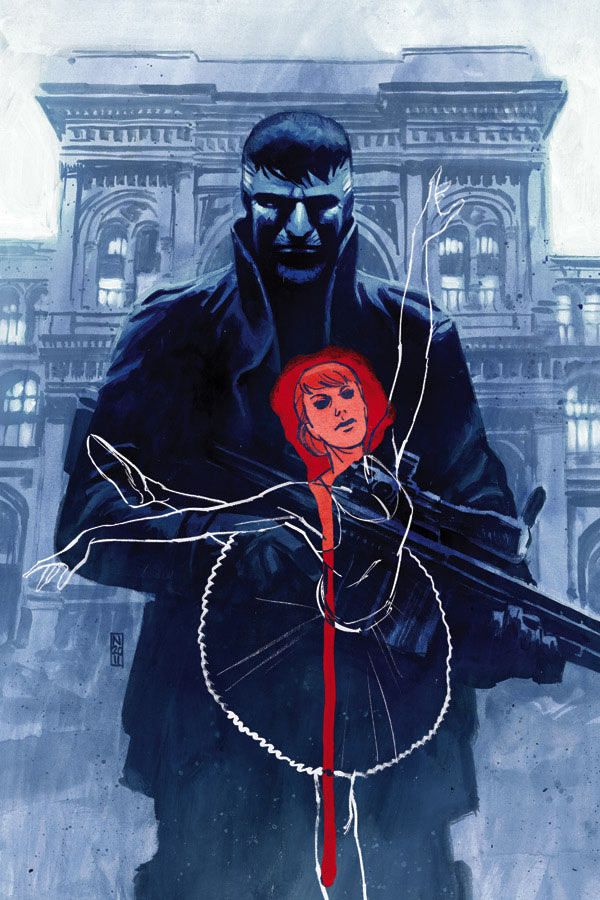
Written by Nathan Edmondson, with fantastic art by Nic Klein, DANCER, now in trade by Image Comics, is a must have for any fan of sci-fi action and drama! Retired hit-man, Alan Fisher must confront his past — in the form of himself! Wait, what did I just say? That’s right kiddies….Alan Fisher must come out of retirement to save the woman he loves, who just so happens to have been kidnapped by a younger, cloned version of himself. Insanity!!!
This story has it all…and I HIGHLY recommend you pick up this bad-boy the minute it hits your comic shop shelves!!!!
Your comic pal,
Donnie Drama
Movie Reviews of Frankenweenie, The Paperboy and Sister by Howard Casner
Posted: October 25, 2012 | Author: Donald | Filed under: Uncategorized | Tags: Alexandra Walker, Antoine Jaccoud, DAvid Oyelowo, Frankenweenie, Gilles Taurand, Gillian Anderson, John Cusack, Kacety Mottet Klein, Lee Daniels, Leonard Ripps, Martin Compson, Matthew McConaughey, Nicole Kidman, Peter Dexter, Rick heinrichs, Sister, The Paperboy, Tim Browning, Tim Burton, Ursula Meier, Zac Efron | 13 Comments »Frankenweenie is the full length version of director Tim Burton’s short film called, astonishingly enough, Frankenweenie. The 87 minute version is written by Leonard Ripps and directed by the aforesaid Burton. Like the short film, the story here is your basic boy meets dog, boy loses dog, boy gets dog, but with a Mary Shelley twist. Victor, a young boy in high school (who for some odd reason starts out as a filmmaker and then suddenly switches a third of the way through to become a scientific genius, a standard trope in Hollywood these days, I guess), figures out a way to bring his pet dog Sparky back to life after it is hit and killed by a car. While this version is not boring and is enjoyable enough, I can’t bring myself to say it’s much more than that. The short was clever and refreshing. The full length feels a bit padded and bloated, filled with some extra monsters created the same way Victor brings Sparky back to life, but with no real explanation as to why they turn out so differently than Sparky does (other than that the story needed padding). The strongest aspects of the movie are some beautiful miniatures (Rick Heinrichs, Tim Browning and Alexandra Walker did the production design and art direction) of an Andy Griffith like home town filled with Leave it to Beaver houses, as well as stark and effective black and white photography that makes you think the story might turn into a duck and cover educational film at any moment (the time period is the ‘50’s). The city the story takes place in is called New Holland—it’s unclear why since no one is Dutch. Well, there actually is a reason—it’s to justify the existence of a windmill so the climax can mimic that other movie with Boris Karloff. In the short, the windmill was located in a miniature golf course—a cleverness this version often lacks.
The Paperboy is a southern melodrama that out Gothics William Faulkner, Flannery O’Connor and Tennessee Williams put together (the various fetishes dramatized here read like a typical night out at a German S&M bar with water sports not of the Olympic kind and Black on White bondage and torture). Though Nicole Kidman is in it, it’s Zac Efron who is sexually exploited here with the writers (Peter Dexter, who also wrote the book the screenplay is based on, and Lee Daniels, who also directs) going out of their way to film him in tighty-whities and shorts (in all fairness, Matthew McConaughey also bares his butt a couple of times, but I suspect that that’s only because it’s a standard clause in his contract). The movie starts out well, but soon loses its way and finally seems to stop going anywhere. This may be because it feels as if something is missing at the core of the story. It’s about two reporters (the aforesaid McConaughey, and David Oyelowo, as a somewhat fey version of Sidney Poitier) investigating the conviction of a man on death row in the home town of McConaughey’s character. What’s missing is a compelling or convincing reason why they care, or perhaps more importantly, why their paper, and only their paper, cares. Without this, it’s unclear that anything is at stake and the tension quickly seeps out of the story, with it all becoming a tough swamp to slog through, both literally and figuratively. No one gives a bad performance, while Kidman and John Cusack (as the weirdo on death row) giving the strongest. To be honest, McConaughey does push his bit a bit too much, as he is wont to do, but Efron in the title role (he plays McConaughey’s younger brother) is surprisingly good, until he has to really emote; but even then, he does well enough for the circumstances. In the end, though, the story is never quite believable, especially a Governor’s pardon resulting from a newspaper story based on anonymous sources that is obviously full of lies (hey, it could happen). The movie might have worked a little better if everybody, including Dexter and Daniels, were having a bit more fun with it (or any fun at all), but no, everyone is deathly serious here. So, if a ranking would help, when all is said and done, this is no Killer Joe, which in its turn is no The Killer Inside Me.
Sister is the Swiss entry in the Academy Award foreign language film category. Written by Antoine Jaccoud, Gilles Taurand and the director Ursula Meier, it’s a very solid and at times moving character study of Simon, a young teenager who goes to a resort in the nearby mountains and steals equipment and skis and sells them to make money to support himself and his sister. Simon is played by Kacey Mottet Klein, who handles the role as capably as his character steals. You may not approve of what he does, but you have to admire his lack of self pity, his self reliance and his Trump-like entrepreneurship. The story grows in strength once the big reveal is, well, revealed, and matters get far more complicated, both emotionally and practically. There are strong guest turns by Sweet Sixteen/Red Road’s Martin Compson and The X-Files Gillian Anderson. The somewhat downbeat subject matter ends on a glimmer of hope, slim as it may be.
Review of the Movie The Perks of Being a Wallflower by Howard Casner
Posted: October 23, 2012 | Author: Donald | Filed under: Uncategorized | Tags: Emma Watson, Ezra Miller, Logan Lerman, Stephen Chbosky, The Perks of Being a Wallflower | 173 Comments »Oh, if only my painful and agonizing years in high school were as painful and agonizing as Charlie’s, the hero of the new coming of age film The Perks of Being a Wildflower. There’s something so beautiful and rhapsodic about Charlie’s freshman year that serves as the plot of this movie, that one not just envies him, one feels robbed of a true right of passage to pre-adulthood. Why does he get to have all these horrible things happen to him? Why is he so blessed? What’s wrong with me?
The movie is pure nostalgia with all the depressing sweetness that description implies. This also means it’s not a realistic depiction of what happened, but a heightened romantic view of that period of time (it has moments with the same feeling as the opening scenes of Evelyn Waugh’s Brideshead Revisited—a look at college life so hauntingly beautiful that it’s too excruciating to experience a second time). And the writer/director Stephen Chbosky (who also wrote the book the screenplay is based on) does something well nigh impossible—he’s made a coming of age film that is not only worth seeing, but actually gives coming of age films a good name.
Charlie (played by the waiflike Logan Lerman, who is heartbreaking from the moment he appears on screen) is a wallflower, but for good reason. It’s not long before it’s revealed that something awful has recently happened to him that is preventing him from connecting with people (what that is, is soon revealed, but in such a casual and off the cuff way that it socks you in the gut). It’s not much longer before you realize that there’s something even deeper than that going on. Everyone hints at it (they mention him seeing things, black outs, he has mysterious flashbacks to an aunt he deeply loves, etc.), but it’s not until the end of the movie that the whole story comes together.
But Charlie’s determined not to let his past become his future, so he goes to a football game (an experience he obviously has no essential interest in; he just as obviously has no idea what is going on on field), and there he takes a chance and talks to another misfit like himself, Patrick (the excellent Ezra Miller, who played the sociopathic son in We Need to Talk About Kevin), and through Patrick, Charlie meets Sam (the spot on and refreshing Emma Watson, doing perhaps an even more successful job of making one forget that she was in the Harry Potter films than Daniel Radcliffe did in The Woman in Black)—the next thing you know, Charlie’s going to parties; eating pot brownies and taking LSD; and attending midnight shows of The Rocky Horror Picture Show (yes, Virginia, the story takes place in the 1980’s). And he slowly sees the end of the tunnel approaching until…well, see the movie and find out.
Charlie is what in screenplay parlance is called a reactive character, a character that doesn’t have a clear and strong goal (other than trying to survive or get though a difficult situation), but whose story is told in his reactions to everything going on around him. If you read any books on screenwriting, they almost invariably state that such a character is anathema to the essence of successful story telling. This, of course, as movies like …Wallflower show, is “malarkey”, to quote a recent Vice Presidential debate (a “whopper” to quote a Presidential one).
But it’s pertinent in many ways to the theme of the movie here. At one point, Patrick points out the “perks” of Charlie’s reactivity—he is the only one who can interpret everything going on around him because he is not actively involved; he is the one who is the stand in for the audience, who tips us off as to what the real meaning of the events he and everyone experiences are; he is the one who can see things no one else can because he is the Observer (complete with that capital O). It’s his reactivity that drives the story and gives him the ability to have insight where no one else does. It gives him his place in the world. Characters like Charlie are just as indispensable to art as active characters like Indiana Jones and James Bond. They may even be more indispensable—characters like Jones and Bond tells us almost nothing about life except that it isn’t remotely like it is in the movies; characters like Charlie do almost nothing but tell us about life.
The movie is not perfect. There is so much tragedy at times that it almost threatens to bring to mind Birdie Coonan’s line in All Above Eve: “What a story! Everything but the bloodhounds nippin’ at her rear end”. Chbosky’s dialog is witty and strong, but at times he lacks a deft hand at directing actors so that some lines roll a bit clunkily off the tongue. And some of the adult characters feel wasted (especially Dylan McDermott as Charlie’s father who feels cast below his pay grade). But I also feel like I’m kind of carping here.
…Wallflower may be full of tragedy, but Chblosky is essentially an optimist. He does not take the nihilist view of Gregg Araki and Larry Clark that describe American youth as a generation of sociopaths and lost souls on the eve of self-destruction. For him, the kids are not exactly all right, but they are not lost. They have a future and the inner strength to go for it, but it’s not an easy road.
The movie’s also pretty swell.
Movie Review of The Woman in Black by Howard Casner
Posted: October 19, 2012 | Author: Donald | Filed under: Uncategorized | Tags: Ciaran Hinds, Daniel Radcliffe, Hammer, James Watkins, Jane Goldman, Janet McTeer, The Woman in Black | 6 Comments »When I was a mere barefoot boy with cheek, every Saturday my local theater had a special matinee for kids and we saw either a Japanese monster film (Godzilla, et. al.); a sword and sandal story inspired by Greek and Roman myth or characters (often starring Hercules, whether he was actually the original character in the Italian film or not, that’s how it got translated); or a Hammer horror film. I have fond memories of that period and the few things I learned as a virginal pre-teen: never remove small miniaturized people from remote islands; never fight sword wielding skeletons; and perhaps, most important of all, never, ever go to a small, remote village in England. If you do, you will likely never return alive.
Yes, it seems that beneath the quiet exterior or tea and crumpets and bland food, in every small and quaint British village exists an evil that no mere mortal can conquer (or if you do, it will just come back again some day—isn’t it fortunate for studios that their desire to create franchises intersects so beautifully with the way evil works in the world). This view of rural England has become an institution for such a long time now, it has even earned its own filmic satire in Simon Pegg’s Hot Fuzz. And true to form, The Woman in Black, the new Hammer horror film written by Jane Goldman and directed by James Watkins, revels in this gothic tradition.
The Woman in Black is star Daniel Radcliffe’s attempt to play adult characters and leave his iconic role of Harry Potter behind. From the look at things, he couldn’t find a screenplay he liked enough that required full frontal, so he settled for this one. And he does an excellent job of playing the father of a young boy (complete with five o’clock shadow to make sure you know he’s more than old enough to shave—Radcliffe, not the young boy); a father in deep, but deeply buried (this is England after all), anguish over the death of his wife. And Radcliffe has a quiet intensity that works very well in a movie that is made up of many moments of quiet intensity.
However, it must be said that in spite of an excellent supporting cast made up of a group of actors who look like they’ve always lived in a village that has yet to install electricity, as well as solid performances by the better known Ciaran Hinds and Janet McTeer (as the noblesse oblige upper crustaceans), the real star of the movie is a fantastical house located far away from everything that can only be reached by a road that is only available at certain times of the day due to tides (it’s so evil, no other building is willing to be near it, I guess). Often seen from above and far away, it’s located on an island of malevolence asea in a marsh of grayness. It’s one of those locations (as in the movie The Haunting) that is a character unto itself, and often a more fully developed one than any other character in the film. And believe me, one look at this architectural monstrosity (in more ways than one) and you’re screaming at Radcliffe, are you crazy, flee, you idiot, flee for your life.
The basic story revolves around something happening to the children in this village. They’re all killing themselves. It seems to have something to do with the owner of the house, but when Radcliffe arrives in his role as solicitor in order to wrap up lose ends now that the house’s owner is dead, the villagers all turn they’re anger on him. It’s unclear why, and this does lead to the main issue with the movie. It’s very scary at times, often terrifying, but it never really holds together. The basic idea of the curse is great, but the execution of it in the screenplay doesn’t always feel as if makes enough sense.
Once Radcliffe gets to the house he’s suppose to get to work, but exactly what he’s supposed to do is never quite clear. In fact, he never really does much of anything (the movie begins with a warning from his employer that this is his last chance at keeping his job and with the work ethic he shows, no wonder). But Radcliffe quickly becomes far too busy being distracted (by creaking doors, mysterious sounds and a vague and distant image of a woman in black) to make a remote dint in the piles of junk that surround him in the house.
But the one issue that really prevents the plot from coming together as it should is that Radcliffe’s character, for some reason that is not satisfactorily explained (at least for me), never asks why everybody hates him; why the children are all dieing; and what everybody is afraid of. Because of this, when he finds himself ensconced in the house, the story has no place to go because there is no rhyme or reason as to what is going on. Instead, what the audience gets is an arbitrary series of jump and go boo moments that, indeed, yes, are very jump and go boo and more than make the hair on your arms stand on end. But at the same time, this section also becomes a tad repetitious and has little forward momentum.
And because the back story doesn’t seem to have been fully thought out (why exactly is the Woman in Black the woman in black), the ending, which is a bit shocking, doesn’t resolve anything in the story and actually says that everything that came before was pointless.
But still, for what it is, it definitely does what it needs to do: scare the bejesus out of you. And it teaches another important lesson. The more things change (Hammer is now under new management and has just recently go back to producing films), the more things stay the same: never, ever go to a small village in England or you may never come back alive. It’s just common sense.
REAL Short Box Subscribe!